 From The Editor From The Editor
Welcome to this month]s MAGIC Preview, offering a peek at what's coming in the May issue of MAGIC Magazine.
If you're not a subscriber, I hope this will get you interested in giving us a try. Please check out our risk-free, one-month-at-a-time subscription plan at the bottom of this email. Of course, we still offer our annual subscriptions as well.
If you are a subscriber, these MAGIC Previews give you an advance look at what's en route to your mailbox. And, of course, you'll still receive our exclusive MAGIC eUpdates with all the latest television news.
Stan Allen
P.S. Feel free to forward these monthly Previews to your friends. If you received this from a friend and would like to be added to the list, please send an email to preview@MAGICmagazine.com.
MAGIC Live! 
It's official, the unconventional convention, August 16-19, 2009, is sold out! Of course, we're still four months out, so we are expecting some cancellations.
If you're still interested in attending, please get on our waiting list today. In 2007, we were able to accommodate almost everyone on that list and we're anticipating doing the same this year. All we need from you is some information – no money, no commitment. When a spot opens up, we'll get in touch with you. To sign up, visit the MAGIC Live! page at www.MAGICmagazine.com, or give us a call at (702) 798-0099, ext. 110.
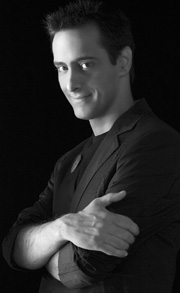 Luis de Matos Luis de Matos
This month, we feature Luis de Matos, whose thirteen-part series, Misterios, is currently airing throughout Portugal on the RTP television network. While Luis is a veteran of hundreds of TV hours, this show was different – he was in total control. But, as David Britland points out in his story, "The Making of Misterios," creating a television show is like riding a roller coaster. And David knows of what he speaks, having supplied magical expertise for TV in the UK for the last twenty years. In his words:
It begins with a long slow climb. You chat about what the show will be. You do research. You plan. You visit locations. You imagine all the wonderful items you will film. There are even some leisurely lunches as you get to know the crew. Then you reach the peak of the first hill. And you plummet down the other side at incredible speed. People start to scream.
The following excerpt from David's story is certainly the "plummet down the other side at incredible speed" part of the Mysterios shoot, but it also shows how Luis and his team react and recover.
July 12 is the first day of the studio shoot. It is a complete disaster. Everything takes too long. Cameras are out of position, shots and lighting cues are missed, crewmembers leave their positions without explanation, even the tripod wheels squeak against the camera tracks. This takes its toll not only on the crew, but also on our celebrity guests.
 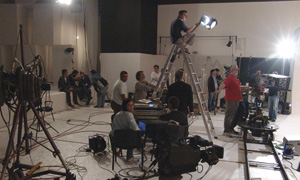 But celebrities need taking care of. There are no big celebrity fees to be had on this show, and these celebrities are not on a promotional tour. Out of respect and friendship, each has taken time out of his or her schedule and traveled to Studio 33 to be with Luis on his show. Any delays during the taping not only lead to boredom, but make celebrities question whether they made the right decision in coming at all. What they say about the show to their friends when they get back home is of real concern to us. We want them to have a good time, but tonight our celebrities are getting restless. We do our best to make them comfortable, but there comes a point when we have to let them go. Even after they leave, we are still recording way beyond our scheduled finishing time. No one gets dinner. And now the crew is hungry and restless, too. When we finally finish, around midnight, we go outside to the covered catering area. The food is cold. The weather is bitter. Everyone is tired. It is the worst possible start to the shoot. But celebrities need taking care of. There are no big celebrity fees to be had on this show, and these celebrities are not on a promotional tour. Out of respect and friendship, each has taken time out of his or her schedule and traveled to Studio 33 to be with Luis on his show. Any delays during the taping not only lead to boredom, but make celebrities question whether they made the right decision in coming at all. What they say about the show to their friends when they get back home is of real concern to us. We want them to have a good time, but tonight our celebrities are getting restless. We do our best to make them comfortable, but there comes a point when we have to let them go. Even after they leave, we are still recording way beyond our scheduled finishing time. No one gets dinner. And now the crew is hungry and restless, too. When we finally finish, around midnight, we go outside to the covered catering area. The food is cold. The weather is bitter. Everyone is tired. It is the worst possible start to the shoot.
Luis decides to hold a midnight postmortem. All the departments have their say. Absolutely everyone, every single member of the crew, gets a chance to explain why he or she thinks the evening went so badly. I have no idea what they are saying, but body language speaks volumes, and the Portuguese are a very expressive people. Finally, I get to say my piece. Luis translates. Despite the differences in language and perspective, we have all arrived at the same conclusion. Our major problem was a lack of communication. We lay down some basic rules that everyone must now work to follow, and we all resolve to do better in the time ahead.
The climb was steady, the descent was traumatic, but the ride is far from finished.
Subsequent shoots are a vast improvement. On prep days, we prepare the tricks and rehearse the routines. Rehearsing in the studio is not the same time as honing material in performance; the reality is that many of the tricks will get their first real test when the celebrities arrive. This is typical of much magic that is on television. All we can really do is block the routines for the director and resolve any lighting problems. It is a very difficult and fraught process, but the crew is beginning to work as a team. Cameras find their positions. We finally figure out how we can use the pole cam to our advantage, giving it the role of an additional guest at the table – able to peer closely at props and oversee procedure as cards are selected, books are chosen, rings are borrowed, and articles are examined. We find a rhythm to the making of the show. And we are ready for the guests, who now have a cozy greenroom in which to relax between takes. There is also a surprise: After the first trick has been performed and we stop to set up the second, Fatima and Furby bring refreshments for the guests. The moment the celebrities see the coffee mugs, they break into huge smiles. Each mug has been personalized with a name. It becomes a talking point of each show. From this point on, our guests all leave with a smile and a wonderful souvenir.
Your "ticket" to experience the entire ride is, of course, in the May issue of MAGIC Magazine.
Blackstone's Floating Princess
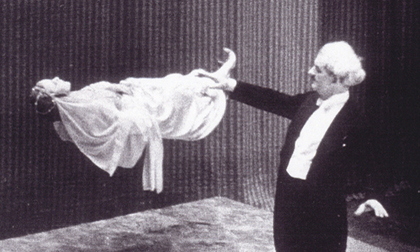 Tom Ewing tells the tale of a small-town girl who ended up defying gravity daily. At 91, she looks back with fondness on her days on the road, portraying Princess Karnac with the Great Blackstone. Tom Ewing tells the tale of a small-town girl who ended up defying gravity daily. At 91, she looks back with fondness on her days on the road, portraying Princess Karnac with the Great Blackstone.
Bernadotta Smith's story begins in 1935 in Tiskilwa, Illinois, a small town of about 1,000 that, like the rest of the country, was struggling through the Great Depression. Smith was seventeen and freshly graduated from high school. She couldn't afford college, and when a friend said he knew of a job, she jumped at the prospect. Little did she realize that within months she would be levitated twice daily – and sometimes more – as Harry Blackstone's "Princess Karnac."
Tiskilwa had one claim to fame: an Episcopal priest and amateur magician, C.D. Maddox, whom the magic community called Father Maddox. Maddox was a close friend of Blackstone's and was instrumental in helping to organize the International Magic Circle, where C.D. served as chaplain. Bernadotta babysat for the Maddoxes and also cared for their magic doves when they were out of town. Maddox knew Blackstone was looking for a new assistant, and he took Miss Smith up to Chicago to meet Billie Blackstone for an interview.
"It went very well," Smith says. "I was five-feet-one-inch tall and weighed less than 100 pounds, and that seemed to qualify me for the show. I might have even been too skinny, because Mrs. Blackstone told me to go home and gain some weight. She told me to eat lots of bananas, and I did."
Bernadotta began touring with Blackstone in December 1935, and on her very first show – just before Christmas in Dayton, Ohio – she was hypnotized and levitated as Princess Karnac. There wasn't a lot of training, either. "Harry told me what to do, and I did it. Two of the boys brought me out as I reclined on a palanquin, and Harry helped me up. He made the hypnotic pass and I fell backwards, hoping the one boy would catch me. One took my head and the other my feet, as they carried me to the couch. That was pretty much it."
In His Words
Not too many magicians start their acts by bringing out a ventriloquist figure. Not too many jugglers have a card chosen and ultimately fail to find it. Not too many comedians toss their props aside seconds after being introduced and shout offstage, "I'm done!" In fact, not too many magicians, jugglers, and comedians occupy the same body. And then there's Chipper Lowell.
When Mark Nelson caught up with him at the Improv in Las Vegas, one of the first subjects covered was whether Chipper should be interviewed in a magic magazine, since wasn't he a juggler?
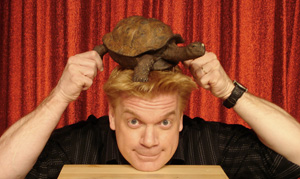 I think that misnomer happened years ago because I did a segment of "dangerous juggling" in my act, and because of another magic routine that involves cigar boxes – that was it. I think that misnomer happened years ago because I did a segment of "dangerous juggling" in my act, and because of another magic routine that involves cigar boxes – that was it.
I think what happens is things get muddied. There's a purist aspect to magicians. Ron Wilson, who booked the Castle for many years, used to want every magician to wear a tuxedo, thinking that's the public perception of what magic is. Even my own father, when I was starting out, was saying, "You really need to decide. Are you a stand-up comedian? Are you a magician? Are you a juggler? Are you a clown? Are you an improv?" I said, "I'm me."
Early on in my career, for about eight years, I heard agents say, "We don't know how to label you, because you do everything in your act. There's a little of this and a little of that, and we don't know how we would put you into shows." Later, those same people said, "You know what's great about you is that we can put you into any show, no matter what, because you present such a wonderful mix." The thing that everyone kept saying I was doing wrong made me easy to sell. This is a fantastic rule of thumb for me. If I get a lot of people telling me I'm going in the wrong direction with something, then usually it's the right direction, both creatively and commercially. There are too many people who just want to pigeonhole everything they see.
More feature stories in MAGIC this month:
• A behind-the-scenes tour of Luis de Matos' new production facility, Estudio 33.
• Bill Malone pays tribute to Ed Marlo through a new DVD set in the hope that a new generation might discover the man in a new light.
• What are the elements that have made magician Jay Alexander a recognizable figure in the San Francisco area?
From the Marketplace
Dan & Dave Buck deliver Andthensome, the fourth volume of their acclaimed DVD trilogy. Here's John Lovick's review:
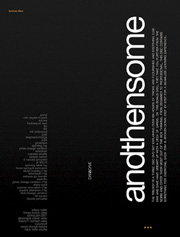 About a year-and-a-half ago, I wrote a review of the Buck brothers' Tricksandflourishesandeverythingelse (the "Trilogy" set). I wrote, "The photography, editing, packaging, and design are sleek and topnotch. [The material is] remarkable... [and the set] is a bargain." Well, the California-based wunderkinden have released Andthensome, the fourth disc in this trilogy, and everything I said about the first three discs is true of this new one. Andthensome includes several different categories of material. The Bucks demonstrate and teach four tricks, three flourishes, nine everythingelses, fifteen andthensomes, and eight extras. This adds up to two-and-a-half hours of material. As one would expect, much of it is eye-popping, visually stunning, extremely magical, and very difficult. About a year-and-a-half ago, I wrote a review of the Buck brothers' Tricksandflourishesandeverythingelse (the "Trilogy" set). I wrote, "The photography, editing, packaging, and design are sleek and topnotch. [The material is] remarkable... [and the set] is a bargain." Well, the California-based wunderkinden have released Andthensome, the fourth disc in this trilogy, and everything I said about the first three discs is true of this new one. Andthensome includes several different categories of material. The Bucks demonstrate and teach four tricks, three flourishes, nine everythingelses, fifteen andthensomes, and eight extras. This adds up to two-and-a-half hours of material. As one would expect, much of it is eye-popping, visually stunning, extremely magical, and very difficult.
Some of the highlights are an interesting variation of the Hank Miller/Ron Wohl false riffle shuffle; Encore, an incredible transposition of the red and black Aces, where the method is as impressive as the effect; Flic, a relatively easy boomerang card toss; Goat, an instantaneous color change of an outjogged card, where the card is never covered; as well as several color changes, card transpositions, double lifts, and aerial flourishes. There are also variations, updates, and tips about items that appeared on the original Trilogy disks.
If you bought and enjoyed Trilogy, you'll definitely want this additional disc. And if you live under a rock and are unfamiliar with the Buck brothers' material, this DVD would make a good introduction.
Andthensome by Dan and Dave Buck. $35 plus shipping (varies by destination). Available from www.dananddave.com.
More products reviewed in MAGIC this month:
The Magic of the Pendragons
Top Shelf by Docc Hilford
The Notebook by Will Houstoun
Inseparable by Jay Sankey
The GatheRing by Jamie Daws
Sick by Sean Fields
Key to Your Card by Stefan Olschewski
New York Coin Magic Seminar Volumes 8, 9, and 10
Routined Manipulation 1 & 2 by Lewis Ganson
Newspaper Magic by Gene Anderson and Frances Marshall
Pentacle by Craig Petty and Steve Bates
The Thing – Platinum Edition by Bill Abbott
Subtle Card Creations, Volume 2 by Nick Trost
The Naked Zombie Ball DVD by Raymond Crowe
Captured DVD by Justin Miller
What Your Future Holds by Rich Marotta
In Watching Others, We See Ourselves
In May, we're introducing "Directions" by Joanie Spina, a new tutorial column that utilizes video clips to illustrate points of staging, movement, pacing, wardrobe, and more. Throughout the text, Joanie lists time codes that correspond with the clips you can find on our website.
If you're looking to work professionally and are unaware of the amazing Joanie Spina, you should definitely find out about her and her work. Start by reading the "In Her Words" interview we published in the July 2008 issue, which is "reprinted" on our website this month. Then, study every point she sets to paper over the next twelve issues. And as an extra nudge, here are the opening few paragraphs from her first installment:
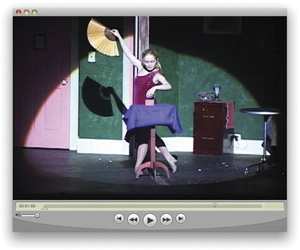 It's absolutely true: in watching other performers, we can see ourselves. We sometimes make the same mistakes or the same brilliant choices, but don't recognize them until we observe them in someone else. It's absolutely true: in watching other performers, we can see ourselves. We sometimes make the same mistakes or the same brilliant choices, but don't recognize them until we observe them in someone else.
Through this series of articles, enhanced by the accompanying videos you can find at www.MAGICmagazine.com, you can learn from watching other performers as I gently point out ways that their material can be improved, as well as the aspects of their acts that are working well. I will not go into every aspect of the performance, but instead I'll touch on selected points. Although they refer directly to the video in question, these points also carry over as general principles of performing. There are many right ways of doing things, and these are a few options.
Your own "critical eye" will evolve with time, study, and exposure to many great and not-so-great presentations. You can learn as much from a poor presentation as a good one. Analyzing why it works or why it doesn't work will help you develop that all-important critical eye. When you recognize the flaws in your performance, you can work toward fixing them. When you recognize what is working about your performance, you can grow with it. You should learn how to determine what needs adjusting – to feel the pacing or a drop in energy, and to identify a choppy transition or an insincere delivery.
And there's even more in MAGIC this month:
• Jeff McBride, a.k.a. The Show Doctor, prescribes good medicine on where to find "good places to be bad"
• Josuah Jay brings us the latest from Chris Mayhew, Doug Brewer, David Neighbors, Cameron Ramsay, Jamie Daws, and Harapan Ong in Talk About Tricks
• Rory Johnston provides Real-World advice on working cruise ships
• Adam Rubin's Braindrops offers a great way to inject some magic into your everyday life
• Abracadabra, the world's only magical weekly, ceases publication
• Magical pranksters come out in "Fools of April"
• And even more!
Click here to see the entire list of what's coming in the May issue of MAGIC Magazine.
Subscribe!
You can now choose to receive MAGIC risk-free with our new "Monthly Subscription" for only $5 each month. Of course, you can still subscribe for the entire year, as well.
Click here for complete subscription details.
Click here to purchase this issue.
|

